Kotyhoroshko, the Boy from a Pea
A boy born from a little pea grows into a mighty hero, defeats a dragon, frees his sister and brothers, then sets off into the world with loyal friends.
- A bit scary
- A bit sad
- A bit dangerous
Once upon a time there lived a man and his wife, and they had six sons and a daughter named Olenka. The sons ploughed a field beyond the forest, and every day their sister carried them their lunch.
“So you won’t get lost,” the eldest brother said one day, “we’ll plough a furrow from our gate all the way to the field. Just follow it, and it will lead you straight to us.”
But beyond a dark ravine stood an iron palace, and in it lived a dragon. He overheard their talk. That night he filled in the brothers’ furrow and ploughed one of his own: deep and straight, right up to his own gate.
In the morning Olenka took a jug of milk and a warm loaf of bread and set off. Along the furrow she went, singing as she walked. Then she looked up, and there were no brothers and no field. Instead, a palace stood before her, black as a sooty old pot. Creeeak! The gates swung open, and the dragon grabbed the girl and carried her inside.
The brothers waited and waited for their lunch, and then they rushed off to look for their sister. They followed the dragon’s furrow and ended up in that very same courtyard.
“Come for your sister, have you?” the dragon roared with laughter. “Then wrestle me on my iron threshing floor. Beat me, and you can take her. Lose, and you’ll sit in my cellar.”
The brothers were strong, but the dragon was stronger. Boom! Boom! He drove them knee-deep into the iron floor and then locked them away in his deep cellar. Their old parents watched the road for their children for a day, a week, a month, but the children never came home.
The mother grieved so much that even the sunshine brought her no joy. One day she went to the well for water, and she saw a pea rolling along the road. It rolled and it bounced, as if it were asking to come to her. The woman picked it up, turned it over in her fingers, and ate it.
Not long after, a baby boy was born to them. They named him Kotyhoroshko, which means Rolling Pea, because he came from a pea that rolled along the road.
The boy didn’t grow by the day; he grew by the hour. In the morning he was lying in his cradle, and by evening his legs were dangling off the bench. Within a week he was carrying logs home from the forest on one shoulder. And when he played with the other boys, they could only clutch their heads: he’d give someone the gentlest little nudge, and off his friend would roll, all the way down to the river.
“Kotyhoroshko, you’d do better rescuing your brothers than knocking us about!” the boys shouted at him one day.
“What brothers?” he asked in surprise.
He ran home.
“Mama, do I have brothers?”
His mother sighed and told him everything: about the two furrows, about Olenka, about the six sons and the iron palace.
“Then I’ll go and rescue them,” said Kotyhoroshko.
“You, my son? You’re still so little!”
“Little, Mama?” he laughed, ducking his head, because it was already touching the ceiling. “I have to squeeze through the door sideways!”
So Kotyhoroshko went to the blacksmith.
“Uncle, please forge me a mace. Make it so heavy that nobody but me can even budge it.”
The blacksmith gathered up all the iron he had and hammered away day and night: clang-a-ling, clang-a-ling! Kotyhoroshko took the mace and tossed it up into the air, and as it came back down, he held out his hand to catch it. Crack! The mace split clean in two.
“Too flimsy,” he said. “I need a heavier one.”
So the whole village brought whatever they had to the smithy: old ploughshares, horseshoes, axe heads without handles, rusty chains. The blacksmith and his helpers hammered for three days and three nights. The mace that came out was so heavy that ten men could barely roll it into the yard, and the ground groaned beneath it.
Kotyhoroshko picked it up with one hand, swung it, and whoosh! The mace soared into the sky, higher than the clouds. People tipped their heads back and waited and waited, but it didn’t come down.
“Well then, I’ll have a little nap in the meantime,” said Kotyhoroshko. He lay down by the fence and fell asleep.
He slept right through until the evening of the next day. Suddenly, whooo-oo-oo! The sky began to hum and whistle. Back came the mace, rumbling like thunder. Kotyhoroshko got to his feet and held out one finger. Bang! And the mace only bent a tiny bit.
“This one will do,” he smiled.
His mother baked him some flatcakes for the journey, and his father walked him to the gate. Kotyhoroshko slung the mace over his shoulder and set off along the dragon’s old furrow, long since overgrown with wormwood.
He walked through fields and ravines until he saw the iron palace. By a window sat a girl with a long braid, spinning, and tears were rolling down her cheeks.
“Good day, sister!” Kotyhoroshko called.
“Sister? Me?” the girl said, frightened. “My brothers are all in the dragon’s cellar. I’ve never seen you before in my life.”
“That’s because I wasn’t born yet when you were taken. I’m Kotyhoroshko, the youngest. I’ve come for you and for our brothers.”
Olenka threw up her hands.
“Run, little brother, before it’s too late! The dragon will be back any minute. He puts boys like you on one palm and squashes them flat with the other.”
“Let him come first,” Kotyhoroshko said calmly. “Then we’ll see who squashes whom.”
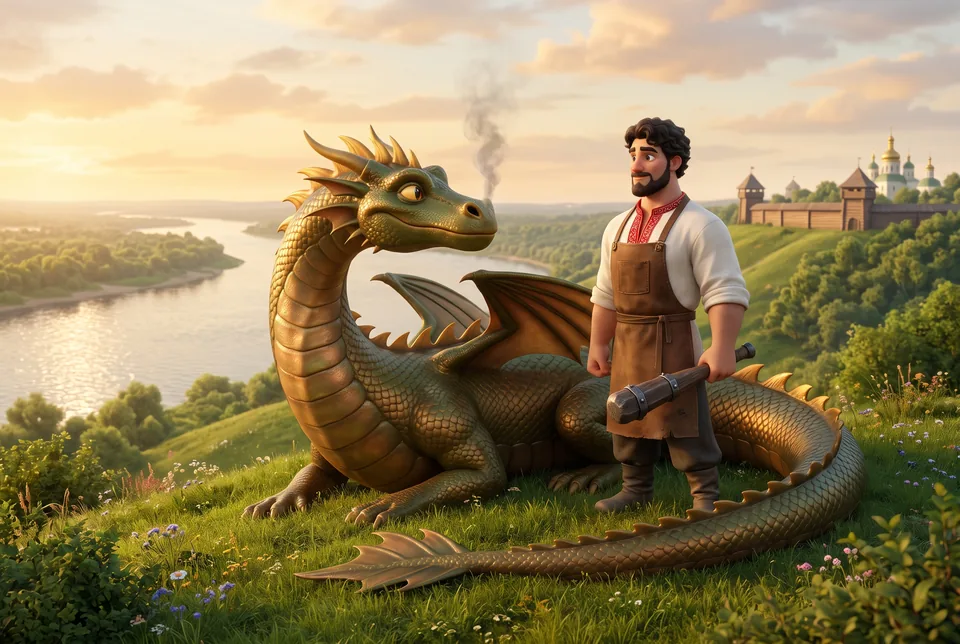
Kotyhoroshko had no intention of running. He walked into the main room, sat down on the bench, and stood his mace in the corner, so heavy that the floor creaked. Soon there was rumbling outside, the wind began to whistle, and the windowpanes rattled. The dragon flew in, stepped onto the threshold, and sniffed.
“Fee-fie! I smell a human! Who’s here?”
“I am. Kotyhoroshko.”
“And what do you want?”
“My sister and my brothers.”
The dragon laughed so hard the walls shook.
“Oh, that’s a good one! Come out to the iron threshing floor, and we’ll talk there.”
“Let’s go,” Kotyhoroshko agreed. “Only you strike first, since you’re the master here.”
Out they went onto the threshing floor, smooth and shiny as ice. The dragon swung, boom!, and drove Kotyhoroshko into the iron up to his ankles. Kotyhoroshko pulled his feet free, raised his mace, ka-boom!, and the dragon sank into the floor up to his knees.
“Oho,” snorted the dragon, climbing out. “Again!”
The dragon struck a second time, and Kotyhoroshko sank in up to his knees. Kotyhoroshko struck, and the dragon was in the iron up to his waist. The third time, the dragon could barely lift his claw, and Kotyhoroshko only wobbled. But when he swung his mace, the dragon sank in right up to his shoulders.
“Enough!” the dragon shrieked. “Take your sister, take your brothers, take everything!”
“You’ve made people cry so many tears,” said Kotyhoroshko, “that no one will ever believe you again.”
And he struck one more time. Clang! Down went the dragon into the iron, head and all, like a bucket into a well. And nobody in the whole wide world ever saw him again.
Olenka came running out with a bunch of keys.
“Our brothers are in the cellar, under the palace! Hurry!”
They went down the steep steps. It was dark and damp down there, and drops glistened on the walls. Against the wall sat six brothers in chains, pale and thin.
“Who’s there?” the eldest called hoarsely.
“Your brother, Kotyhoroshko.”
“We don’t have a brother by that name.”
“You do now,” Olenka laughed through her tears.
Kotyhoroshko took hold of a chain and gave it a tug. Clink! Iron links flew all over the cellar. He broke a second chain, and a third, until all the brothers were free. Then he took his mother’s flatcakes out of his bag.
The youngest of the six took a bite and froze.
“These are Mama’s! I wouldn’t forget that taste in a hundred years.”
They all came out into the light. The brothers squinted in the sunshine and walked slowly, because they had sat still for so long. Kotyhoroshko lifted the weakest one onto his shoulders and dragged his mace behind him along the ground. And behind it a new furrow appeared: straight and wide, all the way to their own gate.
By evening their home came into view. Father and Mother ran out onto the doorstep and stopped still. They looked and couldn’t believe their eyes: six sons, Olenka, and Kotyhoroshko out in front with his mace.
“My children!” the mother cried, and rushed to hug each of them in turn.
That evening the house was noisy and warm. Mother cooked dumplings, Father sliced bread and bacon. The brothers told their story, Olenka laughed, and Kotyhoroshko ate enough for everyone and still asked for seconds.
A week went by, and then another. The brothers were ploughing the field again, Olenka carried them their lunch, and nobody was afraid of strange furrows anymore. But Kotyhoroshko couldn’t sit still. He walked through the house sideways, bumped his head on the ceiling beam, and kept gazing out of the window.
“It’s too cramped for me here, Mama,” he said at last. “And I can see my brothers feel a bit ashamed that their littlest brother rescued them. I’ll go and see the world and look for my own good fortune.”
His mother sighed, but she didn’t stop him: she knew by now that you can’t keep a son like that indoors. Once again she baked him flatcakes, his father walked him to the gate, and Olenka tied a red ribbon around her brother’s wrist.
“So you won’t forget us.”
“How could I ever forget?” smiled Kotyhoroshko. He slung his mace over his shoulder and set off wherever the road might take him.
He walked one day, then a second. Then the road was blocked by mountains, each one taller than the last. And among them a giant was hard at work: he would pick up a mountain, move it aside like a pot on a shelf, whump!, and start on the next one.
“Greetings, good fellow!” called Kotyhoroshko. “Who are you?”
“I’m Vernyhora, the Mountain-Mover. I move mountains from place to place. And who are you, and where are you going?”
“I’m Kotyhoroshko. I’m off to find my fortune.”
“Then take me with you,” the giant begged. “It’s dull being alone with mountains. They never say a word.”
On they went, the two of them. Then a forest blocked their way, so thick that not even a hare could squeeze through. Among the trees stood a great big fellow pulling up oaks, roots and all, like radishes from a garden bed. Crunch! and one oak was down. Crunch! and another.
“Who are you?” asked Kotyhoroshko.
“I’m Vernydub, the Oak-Puller. I clear roads for people. And who are you?”
“Kotyhoroshko and Vernyhora. We’re off to see the world.”
“I’ve heard about you, Kotyhoroshko,” said Vernydub, narrowing his eyes. “They say you beat a dragon. Here, let me hold that mace of yours.”
Kotyhoroshko handed him the mace. Vernydub grabbed it with both hands, strained, turned as red as a beetroot, and barely lifted it a hand’s width off the ground. But Kotyhoroshko flipped it back onto his shoulder as if it were a feather pillow.
“You’re right, you’re stronger,” Vernydub admitted, and laughed. “Take me along as your friend. All I ever see is oaks, oaks, oaks. With you, at least I’ll see the world.”
Now there were three of them, and the forest parted before them, because Vernydub himself was clearing the way. Beyond the forest a river roared: wide and wild, with no bridge and no ford. On the bank sat a man with the longest moustache you ever saw, its ends hanging all the way down to his knees.
“Don’t worry,” he said. “I’m Krutyvus, the Whisker-Twirler.”
He twirled the left side of his moustache, and the river turned aside. He twirled the right side, and a dry path paved with pebbles appeared on the riverbed. Everyone crossed to the other bank, then Krutyvus untwirled his moustache, and the water ran merrily back along its bed.
“Will you take me with you too?” he asked. “I’m tired of turning rivers around here.”
“The more friends you have, the shorter the road,” answered Kotyhoroshko.
That evening the four friends built a campfire on a hill. Kotyhoroshko shared his mother’s flatcakes. Vernyhora swallowed his whole and sat squinting with happiness for a long while afterwards. Vernydub brought a dry young oak so the fire would last till morning, and Krutyvus twirled his moustache, and a little stream came running right up to them so they’d have something to drink.
When the stars came out, they all lay down on the warm grass. Kotyhoroshko laid his mace beside him and gazed up at the sky.
“Are we going on tomorrow?” Vernydub asked sleepily.
“We are,” yawned Kotyhoroshko. “The world is big. But first, we sleep.”
The crickets chirped softly, and the little fire crackled. Kotyhoroshko looked at the red ribbon on his wrist and smiled. Everyone back home was safe and well, and his loyal friends were snoring beside him. And the strongest boy in the world fell asleep as peacefully as he once had in his cradle.