Kyrylo Kozhumiaka
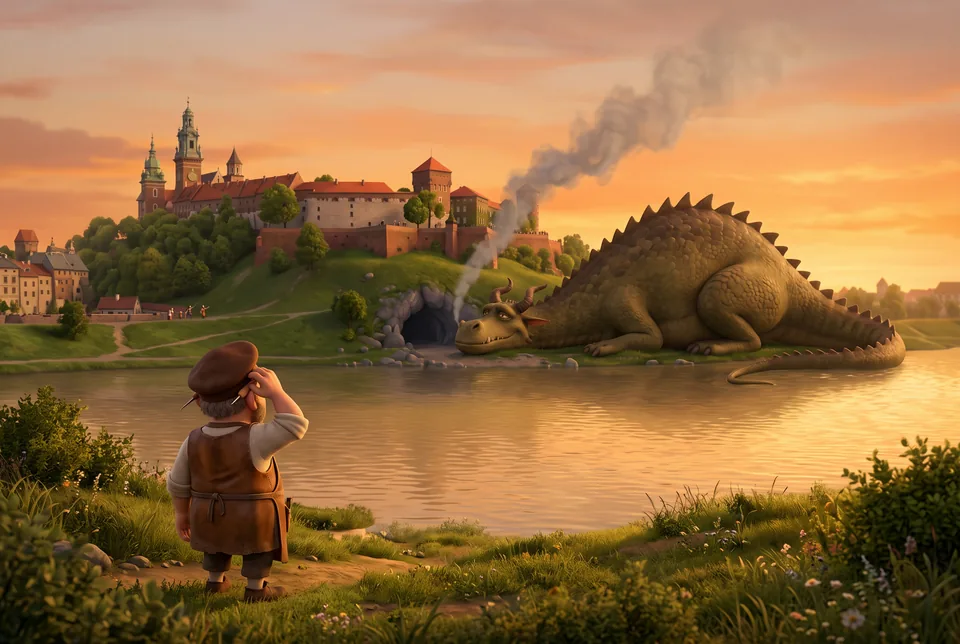
A fierce Dragon has stolen the princess of Kyiv, and only Kyrylo Kozhumiaka, who kneads twelve hides at once with his bare hands, can save her.
- A bit scary
- A bit sad
- Dangerous
Long, long ago, when Kyiv still hid behind wooden walls on the high bluffs above the Dnipro, a Dragon settled not far from the city. He was as big as a good-sized house, with leathery wings as wide as sails, and every so often grey-blue smoke came billowing out of his nostrils.
Every month the Dragon flew to the city gates and roared so loudly that the straw tumbled off the roofs:
“Bring me my tribute! Ten oxen, twenty barrels of honey, and as much bread as I can bite!”
The people of Kyiv sighed, but they brought it. What else could they do? Arrows bounced off the Dragon’s scales like peas off a wall, and spears bent like reeds.
But one spring morning even that wasn’t enough for the Dragon. The prince’s only daughter was out walking in the garden among the blossoming cherry trees. Then all of a sudden: whoosh! The sky went dark and a hot wind blew. Before the princess could even cry out, the Dragon snatched her up in his claws and carried her off over the Dnipro to his cave beyond the dark forests.
The prince ran out into the garden, but all he found were white petals swirling in the air and a red ribbon from her braid lying on the grass.
The Dragon’s cave was deep and black with soot, and it smelled of smoke and old iron. He didn’t hurt the princess, because he wanted her to keep house for him.
“You’ll cook my porridge,” the Dragon snorted, “comb my crest, and praise me every single day. Because there’s no one in the whole wide world stronger than me.”
The princess was not easily frightened. She wiped her tears on her sleeve and thought: “No one stronger, you say? Well, we’ll just see about that.”
So she cooked porridge in a pot as big as a haystack and combed the Dragon’s prickly crest with a wooden rake. And every now and then she would say:
“Oh, Master Dragon, what wings you have! Oh, how your scales do shine!”
Those words made the Dragon purr like a cat on a warm stove.
One evening, when he had eaten a hearty supper and stretched out by the fire, the princess asked, as if it were nothing at all:
“Master Dragon, is there anyone in the world you’re afraid of?”
The Dragon choked on his own smoke.
“Me? Afraid? Ha! Of no one!”
He was quiet for a moment, scratched behind his ear with one claw, and then blurted out, more softly:
“Well, maybe one. There’s a fellow in Kyiv called Kyrylo Kozhumiaka. Him I’d rather not meet.”
“And why is that?” asked the princess, without looking up from the pot.
“Because he’s as strong as a hundred-year-old oak. But don’t you breathe a word!” The Dragon flashed a fierce yellow eye, and a minute later he was snoring so hard that pebbles rattled down from the roof of the cave.
In the morning a white dove flew up to the mouth of the cave. It came from the prince’s own dovecote, and it had eaten out of the princess’s hand ever since it was a chick. It had flown over all the forests looking for her, and it had found her.
The princess tore off a strip of birch bark and wrote on it with a bit of charcoal from the fire: “Father, the Dragon is afraid of only one person, Kyrylo Kozhumiaka. Find him.” Then she tied the little note under the dove’s wing.
“Fly home, my little dove,” she whispered. “Fly faster than the wind.”
Flutter! went the dove, and it melted away into the blue.
The prince read the birch-bark note once, then read it again, and called to his boyars:
“Who is this Kyrylo Kozhumiaka?”
The boyars just shrugged. Then the old stable-keeper spoke up:
“Why, my prince, that’s the fellow down in Podil who tans hides, right by the river.”
In those days hides were softened by hand. They were soaked in the river, then kneaded and rubbed until a skin as stiff as a board turned as soft as linen. That’s why such craftsmen were called kozhumiaky, which means “leather-kneaders.” It was hard work, and not everyone was up to it. But Kyrylo kneaded twelve hides at once.
The prince sent his most important boyars to him, the ones with marten-fur hats. When they got to Kyrylo’s house, steam was pouring out of the door and the air smelled of oak bark. A giant in a leather apron stood with his back to them, kneading a whole pile of hides in his enormous hands.
The boyars knocked: thud-thud!
Kyrylo jumped in surprise. Rrrip! All twelve hides tore clean in half.
“Oh, for goodness' sake,” he muttered. “A whole week’s work!”
The boyars bowed all the way to the ground and told him about the Dragon and the princess. Kyrylo wiped his hands on his apron and frowned.
“First you ruin my hides, and now you want to send me after a Dragon? No, good sirs. I’m a leather-kneader, not a knight. Hides are my business. Let the generals worry about dragons.”
And he shut the door.
So the prince sent the oldest grandfathers in the city, with beards as white as milk and willow walking sticks. The old men sat down on the bench outside his house and set about persuading him. Kyrylo listened and sighed, but he shook his head:
“I do feel sorry for the princess, grandfathers, truly I do. But I’m no warrior. I won’t go.”
The prince was very sad. But then his old nursemaid gave him some advice:
“Send children to Kyrylo, my prince. He has a soft spot for little ones.”
And so they did. Children came from all over Kyiv: from Podil, from the Hill, and from across the river. They stood together in front of Kyrylo’s house, quiet as mice. When Kyrylo came out onto the doorstep, the smallest girl, in a patched coat, stepped out of the crowd.
“Uncle Kyrylo,” she said, “today the Dragon took the princess. Who will he take tomorrow? My sister? Me? Who will protect us, if not you?”
Kyrylo looked at her. He looked at all the children waiting there, holding their breath, and something caught in his throat. He was silent for a long while, and then he waved his hand:
“Oh, what am I going to do with you lot? I’ll go.”
The children jumped for joy and chattered like sparrows on a fence.
Kyrylo got straight to work. He asked for twelve bundles of hemp and a tub of hot tar. He wrapped himself in hemp from head to toe and smeared it with tar. Then he wrapped himself again and smeared himself again, until he looked like a great big black haystack. He made a club out of a whole oak root bound with iron. And he told the blacksmiths to forge him a plough. It wasn’t to be an ordinary plough, though. It had to be so heavy that even ten oxen couldn’t budge it.
“Uncle,” laughed the children, “you look like a bear in a fur coat!”
“Bear or no bear,” Kyrylo smiled, “fire won’t get the better of me so easily.”
He came to the Dragon’s cave and shouted so loudly that acorns rained down from the oaks:
“Hey, Dragon! Come on out!”
First one nostril poked out of the cave, then the other, and then the Dragon’s whole head. The Dragon saw the black haystack with a club and knew at once who it was. But he didn’t let it show.
“What have you come for, Kyrylo? To fight or to make peace?”
“Make peace with the likes of you? I’ve come to fight, Dragon.”
The Dragon breathed out fire: whoooosh! The flames wrapped around Kyrylo and the tar sizzled and smoked, but he just stood there, blinking. Then he swung his club. Bang! The Dragon went rolling across the grass.
And what a fight it was! The Dragon beat his wings till the trees bent and thrashed his tail till the ground rumbled. Kyrylo pounded away with his club till sparks flew off the Dragon’s scales. Whenever the tar went soft from the heat, Kyrylo ran to the Dnipro and dived in head first. Tsssss! Up went a great puff of steam. Then he went back to the fight, as fresh and cool as morning dew.
They fought like that from dawn until noon. The Dragon stopped more and more often to catch his breath. His fire grew weaker, until only little grey puffs came out of his nostrils. At last Kyrylo swung one final time. Ka-BOOM! The Dragon lay stretched out on the grass like a big green log.
“Enough, Kyrylo!” he wheezed. “You win! Don’t hit me any more!”
“Will you give back the princess?”
“Yes, yes, take her!”
But the princess had already come running out of the cave all by herself. Her hair was a mess and her face was covered in soot, but she was grinning from ear to ear.
Kyrylo leaned on his club and looked at the Dragon.
“You don’t hit a fellow when he’s down,” he said. “But I won’t let you off that easily either. You’ve caused people so much trouble. You’ve eaten so many oxen and drunk so much honey. Now you’ll work it off.”
Meanwhile the blacksmiths had brought that very plough on their carts. It was black and heavy, with a blade as wide as a gate. Kyrylo harnessed the Dragon to it, took hold of the handles himself, and called out:
“Hey, giddy-up!”
The Dragon groaned and strained, and then he began to pull. The plough bit into the earth and left a furrow behind it so deep that a rider on horseback could have hidden inside. The earth that the blade turned over rose up on either side in a tall bank.
The Dragon pulled for a day, and he pulled for another. He grumbled and puffed, but Kyrylo kept urging him on:
“Don’t be lazy, Dragon! Didn’t you say there was no one stronger than you?”
And so they ploughed across fields and through oak groves, over steppes and gullies, all the way to the deep blue sea. As soon as the Dragon saw the water, he began to beg:
“A drink, Kyrylo! Just one little sip!”
Kyrylo unharnessed him and said:
“Drink. And then swim away across the sea and don’t come back. I don’t want to see a wing or a tail of you in our land ever again!”
The Dragon flopped into the waves with a splash, and steam rose up over the sea. He drank and drank, and then he swam and swam, until he was just a tiny speck at the edge of the sky. No one in our parts ever saw him again.
But the furrow and the bank are still there. People call those banks the Dragon’s Walls, and they say that if you walk along them, you’ll come all the way to the sea.
When Kyrylo and the princess got back to Kyiv, the bells were already ringing. People had poured out into the streets, and children came running to meet them. The prince hugged his daughter, then turned to Kyrylo:
“Ask for whatever you like, Kyrylo. You can sit beside me in my great hall and be my chief commander. Or I’ll give you a fine house on the Hill and a chest full of gold.”
Kyrylo scratched the back of his head.
“Thank you, my prince. But I’d rather have some new hides. Your boyars ruined my last twelve, after all.”
The prince laughed, the boyars laughed, and the children laughed hardest of all. Everyone thought Kyrylo was joking. But he wasn’t. He didn’t take the fine house, or the gold, or the seat in the great hall. He took twelve hides, bowed to the prince, and went home to Podil.
The next morning the boyars came to his house again. This time they brought a chest of gold with them, just in case he’d changed his mind. When they got there, steam was pouring out of the door and the air smelled of oak bark. A giant in a leather apron stood with his back to them, kneading a whole pile of hides in his enormous hands.
The boyars knocked: thud-thud!
Kyrylo didn’t even blink, and the hides in his hands stayed perfectly whole.
“Take your chest back, good sirs,” he said, without turning around. “I didn’t go after the Dragon for gold.”
“Then what did you go for?” asked the eldest boyar in surprise.
Kyrylo nodded towards the river. On the bank, the little ones were playing Dragon and Kozhumiaka. The smallest girl in the patched coat had wrapped herself in rope from head to toe. She was fiercely waving an oak branch at the “Dragon,” who was laughing so hard he could barely stand up.
“For that,” said Kyrylo, and went back to his hides.
Many hundreds of years have passed since then. The tale has forgotten that prince’s name, and nobody remembers the boyars in their marten-fur hats. But the people of Kyiv still call the spot by the river where Kyrylo kneaded his hides Kozhumiaky.