Puss in Boots
The youngest miller’s son inherited only a cat, but that cat in boots outwitted the king, the mowers and even a man-eating giant.
- A bit scary
- A bit sad
- A bit dangerous
Once upon a time there was an old miller, and he had three sons, a mill, a donkey and a ginger cat. When the miller passed away, the eldest son took the mill, the middle son took the donkey, and the youngest was left with nothing but the cat.
The young man sat down on the doorstep, feeling glum.
“My brothers will at least earn their bread,” he sighed. “But what am I supposed to do with a cat?”
The cat had heard everything. He rubbed against the young man’s knee and said in a perfectly human voice:
“Don’t be sad, master. Give me a sack and a pair of boots, so I don’t prick my paws in the forest, and you’ll see I’m worth more than a mill.”
The young man’s mouth fell open. A talking cat is a marvel already. And this cat was also the best mouser in the whole district. He would lie down in the flour, keep still as if he were asleep, and the mice would scurry — whisk! — right past him. Then he’d — pounce! — and snap!
“Maybe he really will think of something,” thought the young man. He went to the cobbler and swapped his Sunday cap for a pair of small boots.
The cat pulled them on, stamped — tap-tap! — slung the sack over his shoulder and set off for the forest. He put cabbage leaves in the sack, lay down beside it and kept very still. Soon a young rabbit came hopping up to the sack — hop-hop — and poked its nose inside. The cat — a tug on the string! — and the sack was tied shut.
With that sack the cat went straight to the royal palace.
“Your Majesty,” he said, bowing low, so low that his boots creaked, “my master, the Marquis of Carabas, sends you a rabbit from his own forest as a gift.”
There was no marquis, of course. The cat had made up the name on the way, because it sounded grand and important.
“Thank your master,” said the king with a smile. “He must be a very polite man.”
So the cat went to the palace all winter long: one day a rabbit, the next a pair of partridges. The king had even begun to wait for him.
“Ah, something from the Marquis of Carabas again!” he would cheer.
One spring day the cat heard that the king and his daughter, the princess, would drive past the river in their carriage.
“Master,” said the cat, “go and bathe in the river today, over there by the willow. Do nothing else. Leave the rest to me.”
The young man did not understand why, but he obeyed. The moment he stepped into the water, the cat hid his patched clothes under a stone. And when a carriage came rumbling down the road — rrr, rrr — the cat ran out to meet it and shouted at the top of his voice:
“Help! Help! The Marquis of Carabas is drowning!”
The king looked out of the window and recognised the cat who had been bringing him presents.
“Guards, quickly! Save the marquis!”
The guards pulled the young man onto the bank, wet and bewildered. And the cat, squinting slyly, explained:
“While my master was bathing, some tramps stole his clothes. I shouted, but they were off in a flash.”
The king ordered the finest clothes to be fetched from the palace. The young man put on a blue velvet coat with silver buttons, and now nobody would have known him. He was handsome and polite, so the princess looked at him once, looked at him again — and blushed a little.
“Come and sit with us, Marquis,” the king invited him.
The young man climbed into the carriage, and the cat ran ahead, only his boots flashing.
By a wide meadow, mowers were cutting the grass — swish, swish.
“Hey, good people!” called the cat, and he leaped onto a rock. “The king will be driving by any moment. When he asks whose meadow this is, tell him it belongs to the Marquis of Carabas. And if you don’t, you’ll be sorry!”
And he flashed his green eyes so fiercely that the mowers squatted down in fright. Who knows what a talking cat in boots might do? Nobody wanted to find out.
Soon the carriage rolled up.
“Whose lovely meadow is this?” asked the king.
“It belongs to the Marquis of Carabas!” the mowers answered in chorus.
And the cat ran on and on. By the wheat field he told the reapers the same thing, by the orchards the gardeners, by the forest the woodcutters. And wherever the king asked who owned something, they answered:
“The Marquis of Carabas!”
“Well, you have rich lands, Marquis!” the king marvelled.
The young man only nodded, because he did not know what to say.
But in truth all those meadows, fields and forests belonged to a man-eating giant. His castle stood on a hill, and travellers gave it a very wide berth. That was exactly where the cat ran.
Knock-knock-knock! The giant himself opened the door, so tall that the cat could barely make out his beard.
“What do you want, cat?” he rumbled.
“I was passing by and could not help stopping in,” said the cat, bowing. “They say you can turn into anyone you like. Can that really be true?”
The giant roared with laughter so hard that the windowpanes rattled.
“It is true! Watch!”
Boom! — and in front of the cat stood a lion with a thick mane. Rrr!
The cat, scared out of his wits — whoosh, up onto the roof! But his boots slid on the tiles, and he barely held on to the gutter. The lion turned back into the giant and laughed for a long time.
The cat climbed carefully down.
“Oh, you gave me such a fright!” he said, smoothing his whiskers. “But a lion is easy, because you are big anyway. Something small, though, a mouse, say, I bet you can’t do that?”
“Me? I can’t?” said the giant, getting angry. “Watch!”
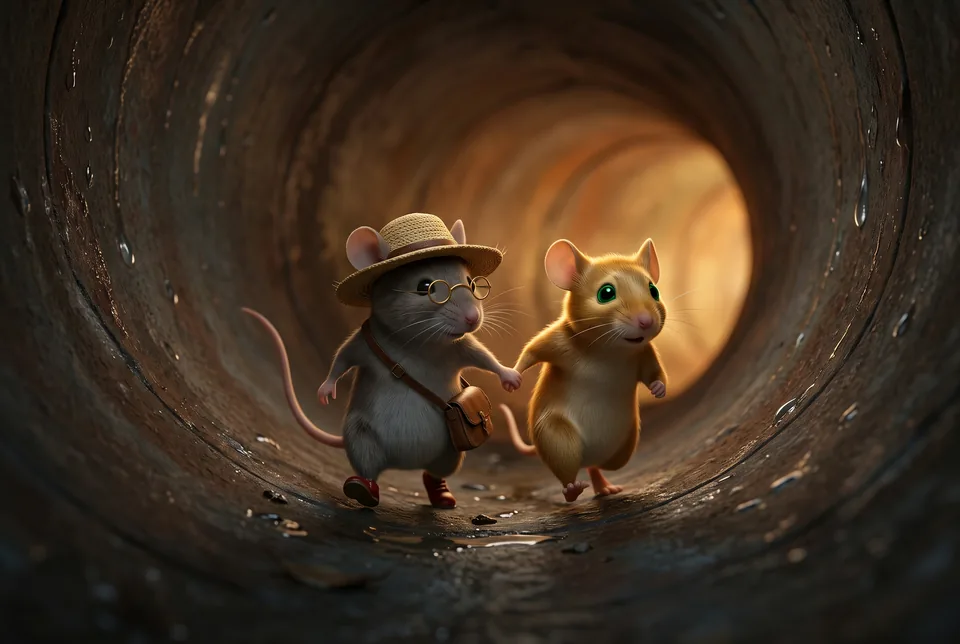
Puff! — and a little grey mouse was running across the stone floor.
That was when the cat remembered what he did best. Pounce! Snap! — and the mouse was in the sack, with the string tied in a tight knot. Nobody ever saw that giant again.
Just then a carriage came rumbling up to the gate. The cat ran out to meet it and bowed:
“Welcome to the castle of the Marquis of Carabas!”
The king could only gasp. Not even he had a castle like this! A table was already laid in the hall: the giant had been expecting guests, but the guests never came. So the king, the princess and the miller’s son sat down at that table.
Soon the young man and the princess had their wedding. The cat became a distinguished gentleman and no longer had to catch mice for his dinner. Now he caught them only for fun. But they say that before every pounce he always looked a little longer at each mouse: what if it was somebody who had changed shape?