Happy Hans
For seven years of work Hans earns a lump of gold, then on the way home he swaps his goods for worse and worse ones, and each time he is delighted.
- A bit dangerous
Once there was a boy called Hans. For seven years he worked for his master: he carried water, chopped wood and mended fences. And one morning he said:
"Master, my time is up. I miss my mother and I want to go home. Please give me what I have earned."
"You served me honestly," said the master, "so your pay will be honest too."
And he gave Hans a lump of gold as big as Hans’s own head. Hans wrapped the gold in a cloth, swung it over his shoulder and set off.
The sun beat down, the road smoked with dust, and the gold pressed on his shoulder until his bones creaked. Hans trudged along, puffing:
"Oh, what heavy happiness this is!"
Just then, clip-clop, clip-clop, a rider on a bay horse caught up with him. He sat there whistling to himself.
"Now there’s a lucky fellow!" said Hans out loud. "He sits as if on a bench, his feet don’t ache, and his shoes are still whole."
"And why are you on foot?" asked the rider.
"I have to be. I’m carrying this lump home. It’s gold, of course, but it won’t let me hold my head straight, and my shoulder is already blue."
The rider narrowed his eyes.
"Do you know what? Let’s swap. I’ll give you my horse, and you give me your lump."
"With all my heart!" said Hans, delighted. "Only I warn you: it’s heavy."
The rider climbed down, took the gold and helped Hans into the saddle.
"If you want to go faster, click your tongue and shout, 'Giddy-up!'"
Hans rode off, and he felt so cheerful that he clicked his tongue:
"Giddy-up!"
The horse shot off at a gallop! Hans bounced once, bounced twice, and thump, into the ditch by the road. The horse would have raced on, but a farmer who was driving a cow the other way caught it by the bridle.
Hans climbed out of the ditch and brushed the thistles off his trousers.
"No, I’ll never ride a steed like that again," he said. "You could break your nose. Your cow, now, that’s another matter! She walks along nice and slow, she throws nobody off, and she gives milk every day, and butter, and cheese. How I’d love to have a cow like that!"
"If you like her so much," said the farmer, "take the cow, and give me the horse."
Hans beamed. The farmer jumped on the horse and galloped away as fast as he could, and Hans drove the cow ahead of him.
"Now I’ll have bread, and butter on my bread," he thought. "When I’m thirsty, I’ll milk the cow. What more could I wish for?"
The road led him up a bare hill with no tree and no stream. The heat was so fierce that his tongue stuck to the roof of his mouth.
"Never mind!" said Hans. "I’ll milk the cow right now and drink some milk."
He tied the cow to a dry willow, held out his cap instead of a pail, and pulled, and not a drop of milk came. He pulled harder. The cow did not like that, and, whack, she kicked him with her hind leg right on the forehead. Hans sat down on the grass and for a long time could not tell the sky from the ground.
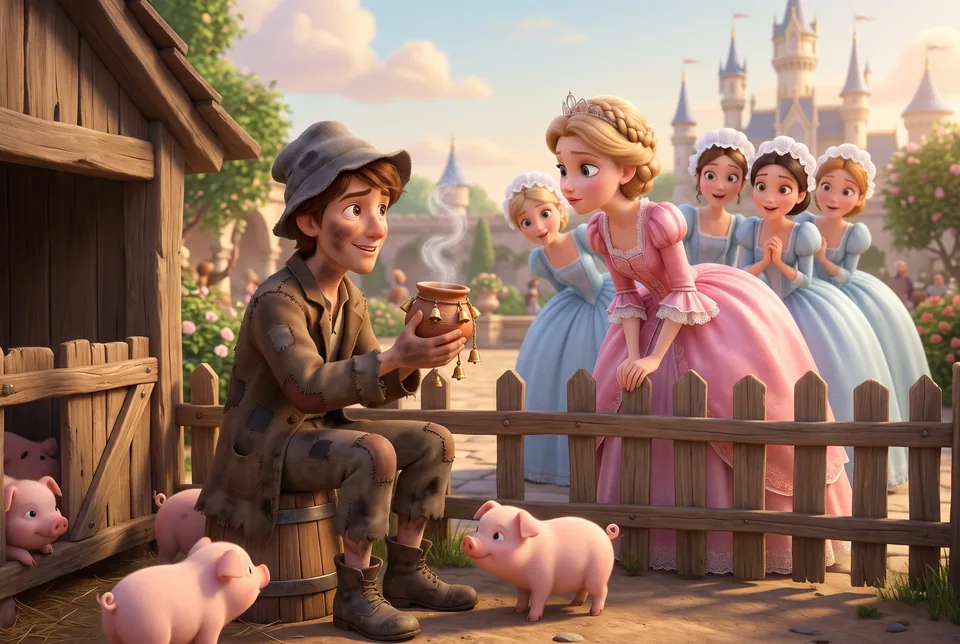
Just then a man came along the road, pushing a young piglet in a wheelbarrow.
"What’s the matter with you?" he asked.
Hans told him.
"Oh, my friend," laughed the man, "that cow is quite old. You won’t get any milk out of her. She might pull a cart, but only just."
"Well, well," said Hans, scratching the bump on his forehead. "And I thought... Now a piglet is something quite different! Pink and cheerful, and it runs after its master all by itself."
"If you like, take it," said the man. "I can use a cow."
Hans gave away the cow, took the piglet on a rope and went on. Isn’t it a wonder: the moment something goes wrong, it mends itself!
Soon a lad with a white goose under his arm caught up with him. Hans at once began to tell him how lucky he was: how he had swapped, and how it had turned out better every time.
The lad tossed the goose up in his arms.
"Feel how plump she is! She’s been fattened for eight weeks." Then he looked at the piglet and frowned. "Listen. In our village the mayor’s piglet has just vanished from his sty. Could that be the very one you’re leading? People are already searching. If they catch you with it, you’ll be in trouble."
Hans went cold all over.
"Oh dear! Help me, you know your way around here. Take the piglet, and give me the goose."
"It’s a risky business," sighed the lad, "but I can’t leave you in trouble."
He grabbed the rope and quickly drove the piglet off down a side path. And Hans walked on with the goose under his arm, light of heart.
"When I think about it, I’ve even come out ahead!" he told himself. "Goose for dinner, and Mother will stuff the white feathers into a pillow. I’ll sleep as if on a cloud!"
Here was the last village before home. In the square stood a knife grinder with his cart, turning his wheel, ding-ding, and singing:
"My wheel goes round, the scissors shine, I walk the world, the road is mine!"
Hans stopped and stared.
"You must be doing well, if you sing so cheerfully?"
"Of course," nodded the grinder. "A good grinder is never out of work: where there’s a house, there’s a blunt knife. And where did you get the goose?"
Hans told him everything from the beginning: the gold, the horse, the cow, the piglet, the goose.
"I see you always knew how to manage," praised the grinder. "Add my trade to that, and you’d live like a king. Here is a grindstone, a little chipped, but still good. I’ll give it to you for the goose."
"You even need to ask!" cried Hans. "I’ll have steady work like you, and I won’t have to worry!"
He handed over the goose, and the grinder picked up an ordinary heavy stone from the ground too.
"Here, have this one as well, as a bonus. It’s good for straightening old nails. Carry it carefully!"
Hans took both stones and went on, beaming.
"I must have been born under a lucky star!" he rejoiced. "Whatever I wish for, I get."
But the day was long, and Hans had been on his feet since dawn. His tummy rumbled: he had eaten his last slice of bread that morning, at his master’s. The stones pulled him down, his back bent, his feet could barely move.
Then he saw a well. Hans carefully laid the stones on the rim so they would not fall, and bent down for a drink. And then he knocked them with his elbow by accident, and both stones, plop, plop, went to the bottom.
Hans watched the ripples spread across the water. Then he jumped up, and tears of joy sparkled in his eyes. He knelt down and thanked heaven for so gently taking those heavy stones away from him, so that he did not even have to blame himself for anything.
"There is no one under the sun happier than me!" he shouted.
And with empty hands and a free shoulder, skipping, Hans ran home to his mother.
"Oh, how light my happiness is!" he laughed all the way.