The New Girl
Hoopoe Dana arrives from the far south as the new girl at the forest school, but autumn will call her away. Will her friendship with Timko wait for spring?
The “Timko” series · story 8 of 9
- A bit sad
Dana flew to Ash Tree Glade in April, when the ash trees were only just unfolding their first leaves. All the way from the far south she had followed her father’s striped tail and pictured her new school. And now she stood under the big maple tree, and her own wings felt like somebody else’s.
“This is Dana,” Mrs Heron said quietly. “She will be learning with us until autumn.”
The whole class turned round. Dana felt the crest on her head fly open all by itself, whoosh, like a fan. She wanted to smooth it down, but her crest never listened to her: whenever she was surprised or nervous, it rose up like a little crown.
“Wow,” someone whispered. “She has a crown!”
Dana did not know whether that was good or bad. She smiled shyly and went where Mrs Heron pointed, to a tree stump by the window.
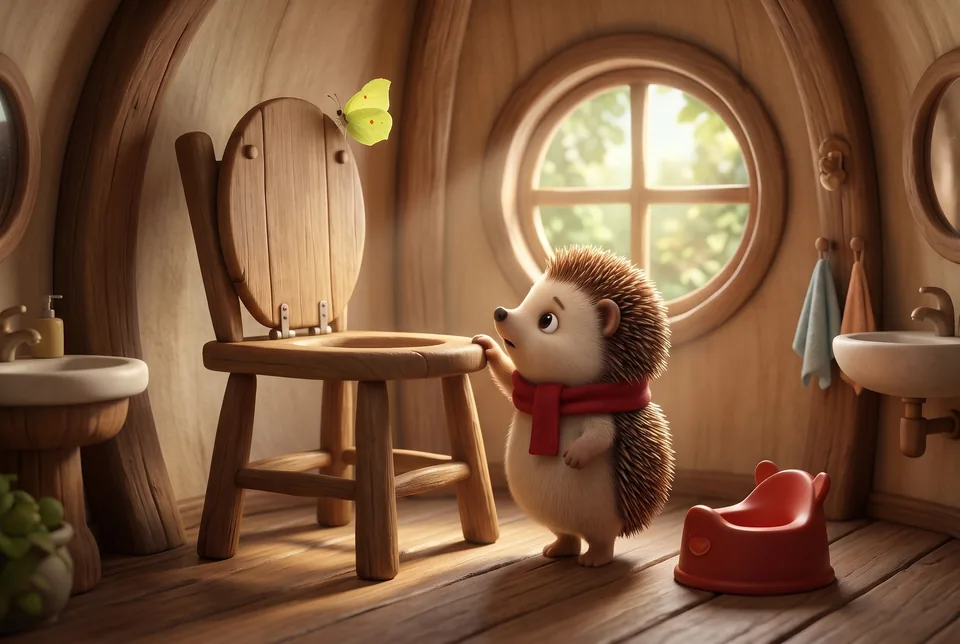
In front of her sat a hedgehog in a red scarf. The scarf was long, wound twice around his neck, and one end was a little brighter than the other, as if someone had knitted it longer later on. The hedgehog looked round, nodded to her and turned back to the board. He did not smile. He did not ask anything. Dana decided that he wasn’t interested in her.
That same morning Mrs Heron called the hedgehog to the board.
“Timko, tell us where Ringing Brook flows.”
Timko stood up. At the board he stopped, snorted through his little nose and said, hardly making a sound, only with his lips:
“Breathe in, breathe out…”
Dana sat closest, so she heard. Nobody else even twitched an ear. And Timko took the chalk and calmly drew how the brook runs across the glade, under the old ash tree and on to the big river.
“So calm,” Dana thought. “And he gets nervous too?” It seemed to her that those two words were some kind of spell. She repeated them quietly to herself, under her beak. It didn’t help. Maybe the spell only worked for hedgehogs.
The next day Mrs Heron asked Dana to tell the class about the land her family came from. Dana wanted so very much to be liked. She stepped forward and spoke fast, almost out of breath:
“The sand there is hot, as if it had just come out of the oven. And the creek is so wide that you can’t see one bank from the other. And there are palm trees! And camels, this tall!”
She stretched out her vowels as if she were singing, because that was how everybody spoke in the south. And she said “creek” where the locals said “brook.” The class listened with open mouths. Dana got so carried away that, from sheer happiness, it just popped out:
“Hoop-hoop-hoop!”
“Wow!” called a little otter in a turquoise swimming cap from the last stump. “Who’s humming into a jug?”
The class laughed. Not meanly, just cheerfully, and the otter himself laughed the loudest. But Dana suddenly felt hot, as if the sand from her story had been poured right under her feathers. Her crest lay flat. She finished quietly and briefly, and on the way back to her seat she promised herself: no more “hoop-hoop-hoop” at school.
“Thank you, Dana,” said Mrs Heron. “I have never seen a camel either.”
That made it a tiny bit easier. But only a tiny bit.
In the evening, in the hollow of the old ash tree, her hoopoe mother was fluffing up the soft bedding and asking:
“Well, my dear? Have you found a friend?”
“Everyone is very nice,” said Dana. And that was true. Nobody had been unkind to her. It was just that everybody had been friends for a long time, with their own games, their own jokes and their own little words, and she had arrived in the middle of spring, like a guest who turns up when the song is already half sung.
For the next few days Dana tried with all her might. She was the first to raise her wing at every question. She brought to class the prettiest pebble she could find by the brook, to show everybody. She even learned to say “brook” instead of “creek.” But the harder she tried, the more awkward she felt, as if she were wearing somebody else’s feathers that just wouldn’t lie flat.
The otter was called Splash. At break he was always the first to fly out to the brook, and the whole class ran after him.
“Let’s build a dam!” he ordered. “A pebble here, a twig there… Splash, done!”
And in he plunged, so that the water flew over everybody. Timko, who got the wettest, curled up into a prickly ball in a flash, and then unrolled and laughed along with the rest.
Dana stood by the brook too. She laughed when the others laughed, but always a moment later, as if she first checked whether she was allowed. All around her were noise, splashes and shouts, and she felt as if she were watching somebody else’s game through a windowpane. It turns out that you can feel lonely even when you are not alone.
So at break Dana began to fly off to a low branch of the old ash tree above the ferns. From there she could see the brook and everybody, and nobody could see her. There, when no one could hear, she sang softly:
“Hoop-hoop-hoop…”
Once something rustled down in the ferns. Dana fell silent and froze. Nobody came out. Only later, flying down from the branch, she noticed a thin red woollen thread on a blackberry bush. “The wind must have brought it,” she thought, and took the thread for herself. It was a nice thread, bright.
Friendship does not arrive with one flap of the wings. It sneaks up quietly, like spring.
First Timko silently gave Dana half of his chalk when hers crumbled. Then it turned out that they walked home from school along the same path: the house of Timko’s family, with its green door and porch, stood right by the brook, and the old hollow in the ash tree where the hoopoes had settled was a little farther on.
“Have you lived here long?” Dana asked one day.
“A long time,” said Timko. And nothing more.
Dana decided he had been born here. He knew every path, every pebble in the brook, and Splash always invited him first to any mischief. It’s easy for someone like Timko, she thought. They don’t have to learn to belong.
But Timko noticed more than it seemed. When Splash split the class into two teams for a leaf race and Dana was left standing aside, Timko silently shifted over on his rock and pointed with his paw: sit. When Mrs Heron asked who knew how far hoopoes fly and the class exchanged glances, Timko turned to Dana as if to say: go on, you know. And Dana told them, quietly, without camels or palm trees, how they had flown over the sea for three nights in a row and how her mother had sung in the dark so that nobody would fall behind. This time nobody laughed. And Splash even said:
“Three nights? Wow. I’d be tired after one.”
And one day in May, on the sunny glade, Dana forgot that she had to be careful. She was poking her long curved beak into the soft ground, tap-tap, tap-tap, looking for beetles. Next to her Timko was sniffing the same ground, his nose snuffling.
“There, under that root!” he snorted.
“I see it!” Dana jabbed with her beak. “Oh, it got away!”
“It got away from me too,” Timko laughed. “So we search the same way. You with your beak, me with my nose.”
Then Dana stretched out on a warm rock, spreading her striped wings, and closed her eyes in the sun.
“Are you sunbathing?” Timko asked in surprise.
“We hoopoes love it,” said Dana. “Try it.”
Timko lay down on the rock beside her with his paws flung wide, and they lay like that until the sun hid behind the ash trees. Dana did not even notice when her crest opened by itself, and not from nervousness any more.
At the end of May, by his green door, Timko suddenly stopped. He snorted through his nose. And this time he said it out loud:
“Breathe in, breathe out, and off we go!” And then, quickly, so as not to change his mind: “Mom is asking if you’ll come to our house on Sunday. She’s baking a pie.”
“Why a pie?” Dana wondered.
“Just in case. She always does that when something important is happening.”
Dana flew home wanting to sing across the whole forest. Something important: was that her?
On Sunday the kitchen smelled of apples. Timko’s mom, in a sky-blue apron, set on the table a pie so big that it would have fed half the school.
“I baked one anyway,” she smiled. “Just in case. You can take the rest to Splash.”
On the door frame by the kitchen door hung a small plank with pencil marks. Next to each mark was a tiny drawing: a heart, a backpack, a star, a plaster cross, a tooth, a house, two paw prints side by side. Below ran another row of marks, shorter ones.
“Those are mine,” said a little hedgehog girl in a pink bonnet proudly. This was Lily, Timko’s sister. She had started first grade this year and followed her brother everywhere like a little shadow.
“Well, time for measuring,” said Timko’s dad, a big, greying brown hedgehog in a green waistcoat. He stood Timko against the plank, patted his pockets and muttered, “Now where’s my pencil?”
“Behind your ear!” Dana blurted out before she had time to think. And at once she felt embarrassed.
Dad touched his ear, found the pencil and laughed quietly.
“There you go. Now we have one more pair of sharp eyes in the house.”
He drew a mark above Timko’s head, a good claw’s length higher than the last one, and asked:
“What shall we draw this time?”
Timko looked at Dana.
“A feather,” he said. “A striped one.”
Dana’s crest opened so wide that it nearly brushed the shelf. And Lily jumped around the table and sang across the whole kitchen:
“Hoop-hoop-hoop! Hoop-hoop-hoop!”
Dana froze.
“Where did you hear that?”
“Timko sings like that!” Lily squeaked happily. “Under the ash tree, when he goes to pick blackberries. And in his room, when he thinks nobody can hear!”
Timko turned red to the tips of his ears and curled up a little, as if he wanted to hide in his own spines.
“I was picking blackberries there,” he muttered. “Under your branch. And I heard it. It’s beautiful. I wanted to learn… so you wouldn’t think it was funny.”
Dana remembered the rustling in the ferns. And the red thread on the blackberry bush, which was still lying in her blue satchel.
“That’s your thread,” she said.
“My scarf catches on everything,” Timko sighed. “Mom knits it longer every year, because I keep growing. And it catches.”
And Timko told her something Dana never expected: he had once been the new one too. His family had moved here from Oak Grove, and on the very first day Splash had soaked him from head to toe, and he hadn’t known whether to cry or laugh.
“And the ‘breathe in, breathe out’?” Dana asked.
“They taught me that when I was little. It’s not a spell. It just helps you take the first step. Sometimes right away, and sometimes not so much.”
After that, at break, Dana no longer sat alone on the ash tree. Sometimes she built a dam with Splash, and he, although he splashed her, no longer joked about the jug. Once he even tried to sing “hoop-hoop-hoop” himself, and he gurgled so funnily that everybody roared with laughter, and Dana the loudest.
Summer ran away like Ringing Brook. At the end of August hoopoes began circling above Ash Tree Glade, getting ready for the journey. One warm evening hour Dana and Timko sat on the porch with the green door.
“We’re leaving in a week,” said Dana. “South, to the big river.”
“And I’ll fall asleep when the leaves have fallen,” said Timko. “Until spring. All hedgehogs do.”
“And I’ll fly back in April.”
“And I’ll wake up when it gets warm. Mom says about then.”
They were quiet for a while. Dana was leaving first, Timko fell asleep later. She would fly over mountains and sea, and he would lie curled up in the warm leaves, knowing nothing. A whole half year.
Dana took a feather out of her satchel, black and white, striped. It had dropped out of her wing the week when hoopoes change their feathers.
“This is for you. So that the one on the plank is not only drawn.”
Timko took the feather in both paws as if he were holding something very precious.
“Will you wait for me?” Dana asked quietly.
Timko snorted through his nose and thought for a long time.
“I don’t know,” he said honestly. “I’ll be asleep. I’ve never tried waiting in my sleep.”
Dana looked at the sky, where her family was circling. In spring she would come back to Ash Tree Glade. Maybe Timko would already be on the porch. Or maybe he would still be sleeping, and she would sit on her branch and sing “hoop-hoop-hoop” and wait alone.
Is half a year a lot or a little for a friendship that has only just begun? Someone will fly away, someone will fall asleep, and the friendship will stay somewhere in the middle, between the sea and the leaves. Will it wait for them both?